 Nutritics
When was the last time you gave your menu real strategic attention?
For many operators, the menu is merely the final hurdle, a list of dishes rushed to the printers days before a seasonal launch. It tells the guest what the kitchen can cook and, hopefully, lists the right prices.
But if you view your menu as just a list, you are missing a massive opportunity for margin growth.
We recently hosted the Menu Engineering Masterclass to explore why the menu is actually your business’s most influential sales tool. Moving past the theory, we dove into the gritty details of profitability, operations, and psychology with a panel of experts:
- Annica Wainwright , Co-founder, 2Forks & ‘Menu Geek’
- Laura Mimoun, CMO, Fulham Shore
- James Mobbs, Fractional CMO
If you are short on time, here are the 7 critical lessons we learned about smarter menu engineering.
1. Stop Guessing (And Ask the Kitchen Porter) The biggest mistake in marketing is assuming we know what customers want without checking the data. You cannot fix a menu if you don’t know what is broken.
You don’t need a massive budget to find out. Laura Mimoun shared a brilliant practical tip from her work, turning around the menu at The Real Greek:
“We need to ask everyone. For instance, the KP (Kitchen Porter) is the person who can actually see what’s left on the plate.”
It is a simple, low-cost insight. If a side salad consistently comes back untouched, your KP knows about it weeks before the Head Office sees the sales dip. Before changing a font or layout, talk to your floor staff. They know exactly which dishes confuse guests and which are the silent champions.
2. “I Get Paid in Pounds, Not Percentages” As an industry, we are often obsessed with Gross Profit percentages. We worry if a dish slips a few points on the margin, even if customers love it. James Mobbs delivered a vital reality check regarding this mindset:
“I want cash in till. I get paid in pounds and pence. I don’t get paid in percentage points.”
High-margin items are useless if nobody orders them. Sometimes, accepting a slightly lower percentage on a high-ticket item. Like a premium steak or sharing platter, it puts more actual cash in the bank than a high-margin salad that rots in the fridge.
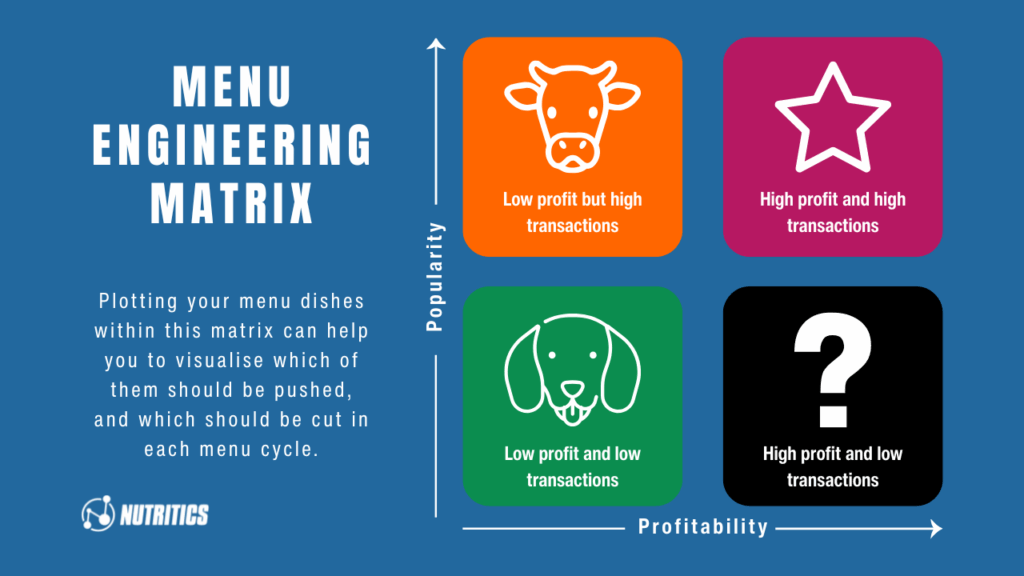
3. Categorise Your “Stars” vs. Your “Dogs” You cannot apply a blanket price increase across your menu and hope for the best. To engineer profit effectively, you must use the Menu Matrix. This helps you categorise every dish based on sales volume and profitability, allowing you to make strategic decisions rather than emotional ones.
4. The Power of the “One Pound” Nudge. Small changes in copywriting and hierarchy can drastically change purchasing behaviour. James Mobbs shared a great example of “reframing” price perception.
If you list “Truffle Fries” as a separate £6 item, it feels expensive to a guest scanning the sides. However, if you list standard “Fries” at £5 and add a sub-option saying “Upgrade to Truffle & Parmesan for £1,” it feels like a bargain.
It is the exact same product and final price point, but the uptake is completely different because the psychological barrier is lower.
5. The Set Menu is a Strategic Weapon. Set menus often suffer from a bad reputation as a discount vehicle. However, Laura explained how The Real Greek used them to drive value perception.
They realised that guests ordering the Set Menu reported higher satisfaction scores. They were getting the “full Greek experience” rather than anxiously trying to piece together a meal à la carte. By highlighting the Set Menu visually, they didn’t just drive value; they simplified the guest journey. Curating the experience often leads to greater loyalty.
6. Operational Simplicity Drives Quality A massive menu is often a sign of a lack of confidence. We discussed the “hamster wheel” of innovation, where brands launch new dishes just for the sake of having something new.
Laura noted that at The Real Greek, they removed roughly 30% of the dishes. Why? Simplifying the operation allowed them to invest in better-quality ingredients for the core items. The result was a less-stressed kitchen and food that tasted significantly better. Menu engineering isn’t just about what you add; it is about what you are brave enough to cut.
7. The PDF Problem (and the Digital Opportunity) Consider this stat: 77% of diners check a menu online before they visit.
If that experience involves pinching and zooming on a static PDF on a mobile screen, you have likely lost them before they walk through the door.
A proper digital menu (like we provide at Ten Kites) does the heavy lifting. It ensures allergens and nutrition are compliant in real-time, allows instant dietary filtering, and, crucially, allows you to promote high-margin specials before the guest arrives.
Taking Control of Your Menu Cycle: A great menu isn’t an accident. It is the result of data, psychology, and operational discipline working in harmony. To help you apply these strategies, we have consolidated them into two key resources:
- Watch the Masterclass: Catch the full panel discussion
- Download the Menu Profit Playbook as a practical guide to help you turn these insights into action.
For more insights and top tips, follow us on LinkedIn Nutritics and Ten Kites or email us with your questions.